
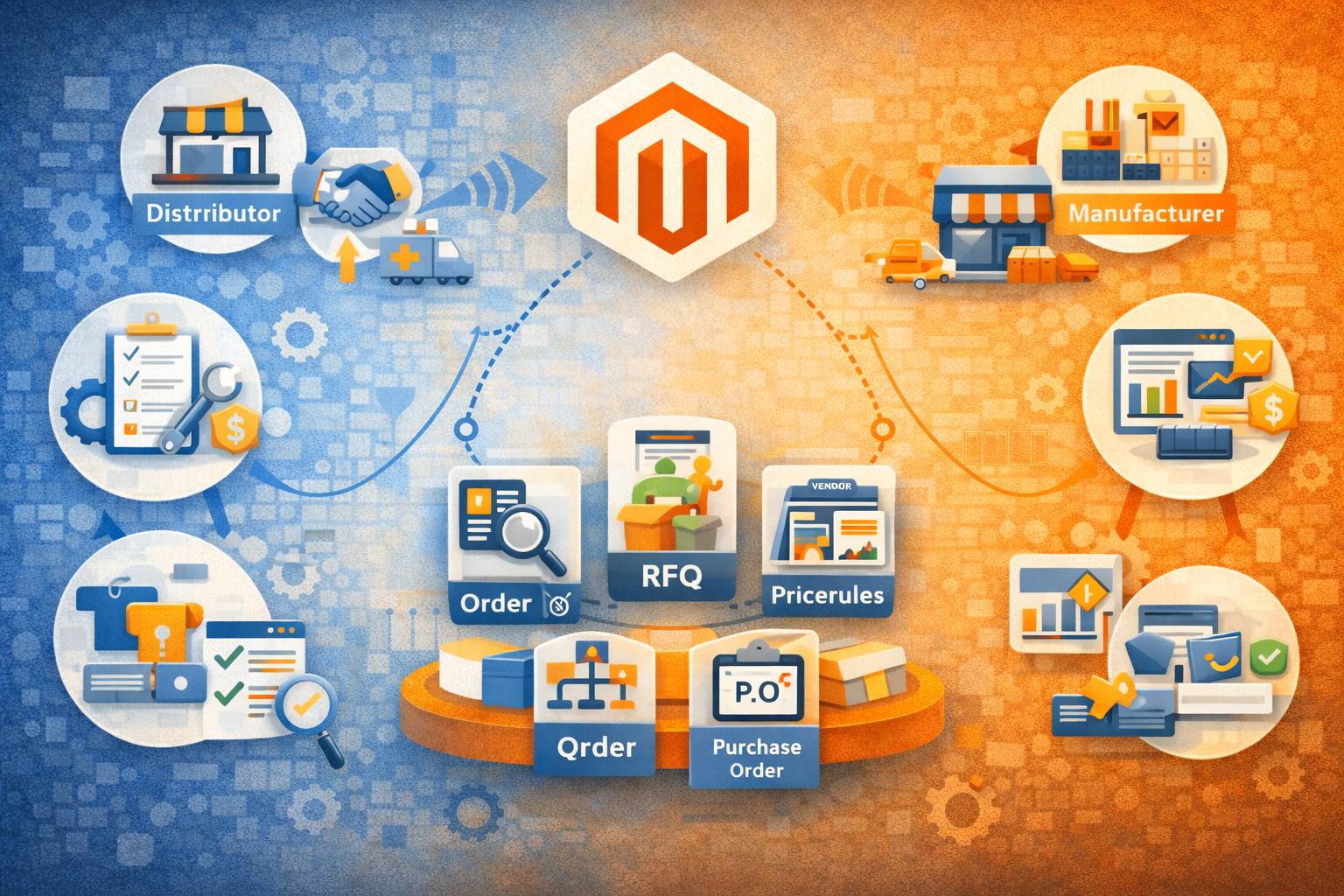
The transition from traditional sales models to digital commerce presents unique challenges for the industrial sector. For manufacturers and distributors, a standard retail-focused e-commerce site is insufficient. These businesses operate on complex logic involving negotiated contracts, high-volume logistics, and multi-layered organizational structures. Magento 2 (Adobe Commerce) provides a robust foundation, but to truly optimize for the B2B sector, specialized extensions are required to bridge the gap between standard e-commerce and industrial-grade functionality.
Manufacturers and distributors operate within a different paradigm than B2C retailers. Their workflows are characterized by long-term relationships, repeat purchasing cycles, and high-value transactions. Unlike a casual shopper who buys a single item, a B2B buyer might be purchasing raw materials for a factory or thousands of stock-keeping units (SKUs) for a retail chain.

Complexity of B2B Workflows
The primary reason for seeking specialized extensions is the inherent complexity of B2B sales. In a distribution model, pricing is rarely “one size fits all.” It is often dictated by historical volume, geographical location, or pre-negotiated legal contracts. Furthermore, the purchasing process involves multiple stakeholders—a procurement officer may fill a cart, but a finance manager must approve the final expenditure.
Key Business Needs: To succeed, these organizations require specific digital tools:
Tangible Business Benefits
Implementing the right Magento 2 extensions leads to measurable improvements. Efficiency is boosted as manual data entry is replaced by automated syncs. Error rates drop because buyers select from their specific catalogs rather than a general list. Most importantly, these tools improve customer relationships by providing a self-service portal that is available 24/7, allowing buyers to manage their own accounts without waiting for a sales representative to return a call.
In addition to these core benefits, merchants often use Magento extensions for product recommendations for B2B customers to deliver personalized suggestions that drive higher average order values.
The foundation of any industrial e-commerce site is its ability to handle business logic. The following categories represent the “must-have” extensions for any Magento-based manufacturer or distributor.
In the B2C world, an account belongs to a person. In B2B, an account belongs to a company. Specialized extensions for company accounts allow businesses to mirror their real-world organizational charts within the Magento storefront.
Key Features:
Business Benefits: These features facilitate tailored pricing and controlled access. They ensure that a manufacturer isn’t inadvertently showing wholesale prices to the general public, protecting the brand’s integrity and its relationships with secondary distributors.
Price transparency is a challenge in distribution. Pricing extensions allow for “Individualized Pricing,” where the price of a product is fetched dynamically based on who is logged in.
Key Features:
Business Benefits: This encourages bulk purchases and protects profit margins. It automates the “negotiated deal” process, allowing sales reps to focus on new business rather than manually calculating discounts for every repeat order.
For many B2B buyers, the “shopping experience” is secondary to efficiency. They know exactly what they need and want to spend as little time as possible finding it.
Key Features:
Business Benefits: These tools significantly reduce the time spent on ordering. By making the process frictionless, distributors reduce the likelihood of “cart abandonment” and improve the overall buyer experience.
Large-scale manufacturing often involves custom specifications or fluctuating commodity prices that make a fixed price impossible.
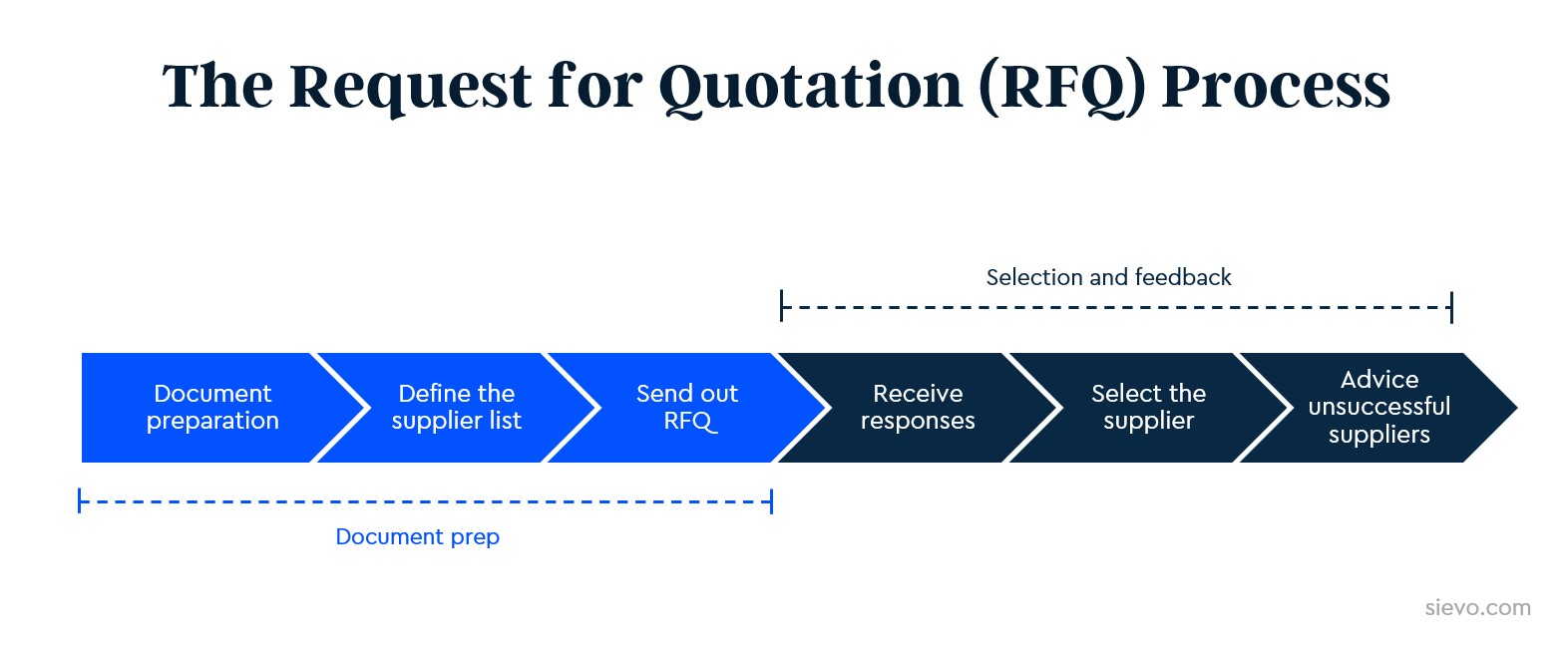
Key Features:
Business Benefits: This provides the flexibility required for complex B2B transactions. It keeps the entire negotiation history within the Magento platform, providing valuable data for sales auditing and forecasting.
For manufacturers and distributors looking to optimize their Magento 2 stores for complex B2B transactions, BSS Commerce offers a full suite of extensions designed to handle every aspect of wholesale and distribution operations. From company account management, tiered pricing, bulk ordering, and quote workflows, to multi-warehouse management, ERP integration, and multiple store views, BSS Commerce provides scalable solutions to meet the unique needs of B2B businesses.
Explore the complete range of Magento 2 B2B extensions here: https://bsscommerce.com/magento-2-extensions.html to discover how you can streamline operations, improve customer experience, and scale your distribution or manufacturing business efficiently.
For distributors and manufacturers, the “Buy” button is only the beginning. The back-end logistics must be equally sophisticated to ensure the product actually arrives at the loading dock.
Global manufacturers often need to serve different markets with localized content. Magento’s native store view architecture can be enhanced with specialized extensions to manage this at scale.
Key Features:
Business Benefits: This reduces the need for multiple, disconnected Magento installations. It provides centralized management at the corporate level while giving local branches the flexibility to run their own promotions and pricing.
For global operations like these, Magento extensions for international B2B businesses play a critical role in managing cross-border pricing, localization, and compliance across multiple regions.
For manufacturers and distributors looking to streamline global operations, the BSS Commerce Multiple Store Views Extensions offers a powerful, scalable solution to manage multiple store views efficiently.
As a business grows, it rarely ships from a single location. Manufacturers may have several production sites, while distributors may utilize regional hubs.
Key Features:
Business Benefits: Accurate stock visibility is critical for maintaining trust. These extensions reduce stockouts and improve fulfillment speed, which is a major competitive advantage in the distribution sector.
The Magento store should never be an island. For manufacturers, the store is a window into the ERP (Enterprise Resource Planning) system.
Key Features:
Business Benefits: Integration saves thousands of hours of manual data entry. It ensures data consistency across the organization and provides the scalability needed to handle thousands of orders per day without increasing administrative headcount.
In some scenarios, a distributor acts as an aggregator for multiple manufacturers, or a manufacturer sells through a network of authorized partners. In these cases, “Marketplace” functionality is essential.
Key Features:
Business Benefits: This centralizes multi-supplier operations. It allows a distributor to massively increase their product range (the “long tail” of products) without having to hold the physical inventory themselves.
Once the core B2B features are in place, manufacturers and distributors can look toward “optimization” extensions that provide a more refined user experience and better operational control.
In B2B, sales reps are often the primary point of contact. They need tools that allow them to assist their customers within the e-commerce environment.
Key Features:
B2B shipping is rarely as simple as a flat rate or “Free Shipping over $50.” It often involves pallet shipping, LTL (Less Than Truckload) freight, and specialized handling.
Key Features:
Data is the lifeblood of manufacturing. Understanding not just what is selling, but who is buying, is vital for long-term planning.
Key Features:
The “Best Magento 2 Extensions for Distributors and Manufacturers” are those that prioritize the specific, high-friction points of the B2B buying cycle. While a beautiful storefront is important, for the industrial sector, functionality is king.
Manufacturers and distributors benefit most by starting with a “Core B2B” foundation:
Once these basics are established, the next level of maturity involves deep integration with ERP and WMS systems to ensure that the digital storefront is an accurate reflection of the physical warehouse. Finally, by adding advanced features like sales rep tools and localized store views, a manufacturer can create a truly global, scalable e-commerce presence.
The goal for any distributor or manufacturer on Magento 2 should be to create an automated, scalable setup. By choosing extensions that reduce manual effort and provide a superior self-service experience for buyers, businesses can not only survive the digital shift but use it as a powerful engine for growth. Success in B2B e-commerce is not about mimicking B2C; it is about taking the complex, manual processes of the industrial world and making them fast, accurate, and accessible online.
