
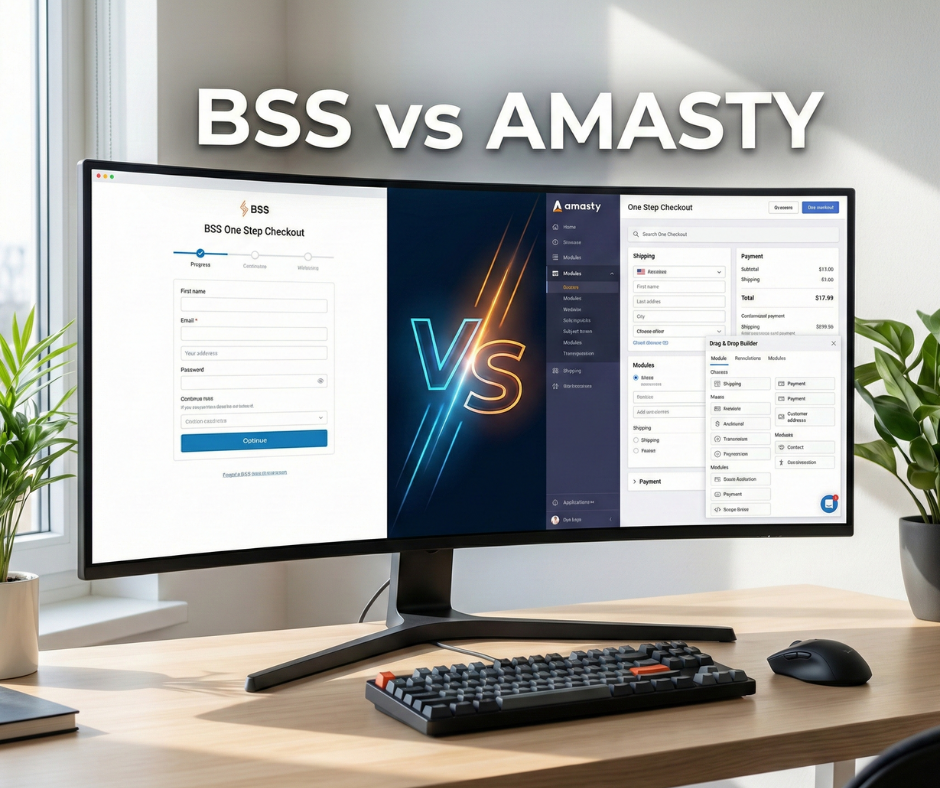
When evaluating BSS Commerce One Step Checkout vs Amasty One Step Checkout, merchants are looking for more than just a reduction in steps; they are looking for a technical foundation that supports higher conversion rates and a smoother user journey. One-step checkout extensions consolidate shipping information, payment methods, and order reviews onto a single page, significantly reducing the cognitive load on the buyer. In the Magento ecosystem, BSS Commerce and Amasty are the two most prominent providers, each offering a distinct philosophy on how to handle the final stage of the funnel.
Choosing between these two solutions is not merely about picking a brand; it is about selecting an architectural approach that aligns with your store’s scale, budget, and performance goals. This comparison covers everything from feature sets and customization flexibility to the technical impact on Core Web Vitals and SEO. By the end of this guide, you will have a clear understanding of which solution provides the best return on investment for your specific Magento2 environment.
BSS Commerce is a recognized Adobe Bronze Solution Partner and a prominent name in the Magentoextension marketplace. Their philosophy centers on providing high-performance, cost-effective solutions that solve specific merchant pain points without adding unnecessary bloat to the system.
The core purpose of the Magento 2 one step checkout extension by BSS is to streamline the path to purchase while maintaining a lightweight footprint. It is designed to be highly compatible with a wide range of third-party themes and extensions out of the box. BSS is commonly chosen by small to mid-size Magento stores that need a reliable, high-converting checkout without the complexity of an enterprise-level configuration. Key selling points include its exceptional customer support, ease of installation, and a clean, intuitive admin interface.
Amasty is one of the oldest and largest extension providers in the Magentoecosystem. Known for their “all-in-one” approach to feature development, Amasty extensions are often characterized by an exhaustive list of configuration options and deep integration with other modules in the Amasty ecosystem.
The Amasty One Step Checkout is an enterprise-grade solution built for merchants who require total control over every micro-interaction on the checkout page. It is highly flexible, allowing for complex layout modifications and a massive array of built-in marketing features, such as gift wraps, delivery date selections, and advanced newsletter subscriptions. Targeting larger mid-market and enterprise profiles, Amasty’s strength lies in its robustness and its ability to handle highly specialized fulfillment workflows or complex B2B procurement requirements.
This section provides a deep dive into how both providers tackle the technical and psychological aspects of the checkout experience.
Both extensions successfully consolidate the standard Magento steps into a single-page layout, but their visual philosophies differ significantly. BSS offers a clean, minimalistic design that prioritizes clarity and speed. It provides three main layout templates (1-column, 2-column, and 3-column) that are fully responsive and touch-friendly for mobile users. The focus here is on removing distractions so the customer can finish the transaction as quickly as possible.
Amasty takes design a step further by offering a highly visual drag-and-drop layout builder. This allows merchants to move blocks—such as the shipping address or the order summary—around the page without touching code. Amasty also includes a GeoIP detection feature that can pre-fill a customer’s country and city based on their IP address, further reducing the effort required to complete the forms. Both extensions offer a superior guest checkout experience compared to the Magento default, though Amasty’s “smart” field detection feels slightly more refined in high-traffic, international scenarios.
Customization is where the two extensions truly diverge. BSS provides all the necessary toggles to show or hide standard fields, change labels, and set default values. It is designed to be flexible enough for the vast majority of stores while remaining simple to configure. For most merchants, the native settings provided by BSS cover every necessary base without requiring extensive technical training.
Amasty, conversely, is built for stores with highly specific or non-standard needs. Its field management system is incredibly granular, allowing for custom validation rules and the ability to add entirely new fields directly from the admin panel. For a merchant who needs to ask specific logistics questions, such as “Do you have a loading dock?” or “Enter your gate code,” Amasty provides the tools to do so natively within the module settings. This depth of configuration makes it a favorite for complex businesses, but can also lead to a steeper learning curve for admin staff.
Both extensions are built to support the majority of standard Magento payment and shipping methods, including PayPal, Braintree, Authorize.net, and various carrier-specific modules like FedEx or UPS. However, the way they handle third-party compatibility varies based on their code structure.
BSS is frequently lauded for its “clean” and standard-compliant code, which often makes it more compatible with third-party, niche payment extensions that might not have been specifically tested with a one-step checkout. Amasty, on the other hand, has built-in compatibility with many of its own shipping and payment-related modules, such as Shipping Rules or Delivery Date. This creates a very stable environment if your store is already built on the Amasty stack, as their modules are designed to work in harmony with one another.

In the era of Core Web Vitals, the performance of your checkout page is critical. A slow checkout can lead to abandonment just as easily as a complex one. Magento checkouts are notoriously JavaScript-heavy, and BSS approaches this by keeping their extension’s code as lean as possible. They minimize the use of heavy libraries and ensure that only necessary assets are loaded on the checkout page. This results in a very fast Time to Interactive (TTI), which is vital for mobile shoppers on slower connections. To see how these speed advantages hold up in various testing environments, you can look into a detailed review about BSS Commerce Magento 2 One step checkout extension.
Amasty’s checkout is more feature-dense, which can naturally lead to more CSS and JavaScript. To combat this, Amasty includes built-in optimization settings to help manage how scripts are executed. However, in head-to-head performance tests on standard Magento installations, BSS often shows a slight advantage in initial page load speed and reduced layout shift due to its smaller overall technical footprint. For merchants prioritizing the fastest possible mobile experience to satisfy search engine ranking signals, the lightweight nature of BSS is a significant asset.
While checkout pages are typically disallowed from being indexed via robots.txt to prevent duplicate content issues, the checkout process has significant indirect effects on SEO. Neither extension poses a risk to site crawlability if configured correctly. They both maintain the standard MagentoURL structure for the checkout path, which search engines know to ignore.
The primary SEO benefit of a one-step checkout is the improvement of conversion-related metrics. Google’s algorithms increasingly look at behavioral data, such as Revenue Per Visit (RPV) and bounce rates. A checkout that converts more efficiently sends a positive signal that the site is high-quality and meets user intent. Both BSS and Amasty are designed with SEO-friendly practices in mind, ensuring that tracking pixels and analytics tags, such as Google Tag Manager, fire correctly throughout the single-page process. This data accuracy is essential for optimizing top-of-funnel SEO strategies based on real conversion performance.
The administrative experience can vary greatly between these two solutions. For developers, BSS is often preferred for its straightforward installation via Composer. Because it focuses on the essential features, the setup is usually predictable and requires minimal troubleshooting. The documentation is clear and focused on getting the checkout live quickly, making it ideal for teams with limited technical resources.
Amasty’s installation is also robust, but due to the sheer volume of features, the configuration stage can take significantly longer. Merchants must spend time navigating through dozens of menu tabs to fine-tune the settings and layout builder. While this provides more power, it also increases the likelihood of a misconfiguration that could lead to user experience issues if not tested thoroughly. Both companies provide excellent documentation, but Amasty’s guides are more encyclopedic, while BSS’s documentation is more concise and action-oriented.
When analyzing the technical requirements of BSS One Step Checkout vs Amasty One Step Checkout, it is vital to consider how they integrate with the broader world of Magento Commerce extensions. Modern stores rely on a complex web of modules for marketing, logistics, and security, and the checkout must serve as a stable bridge for all of them.
Both BSS and Amasty are diligent about keeping their extensions updated for the latest versions of Magento2 and Adobe Commerce. In terms of B2B readiness, Amasty has a slight edge for enterprise clients due to its native support for complex corporate account structures and requisition lists within the checkout flow. BSS, however, offers a dedicated B2B One Step Checkout version that is specifically optimized for wholesale workflows, providing a competitive and often more affordable alternative for B2B-focused merchants who want to avoid enterprise bloat.
The financial models of these two providers often dictate the final choice for budget-conscious merchants. BSS Commerce generally offers a more aggressive pricing model, with their one-step checkout typically sold as a one-time purchase that includes free installation and a year of free support. This makes it an incredibly attractive option for small and mid-sized businesses looking to maximize their development budget.
Amasty uses a tiered pricing model that is generally higher than BSS. While you get more features for the price, the total cost of ownership can be significantly higher, especially when considering annual support renewals and the potential need for more server resources to handle the added complexity of the code. Support quality is high for both; BSS is frequently praised for its personalized, “above and beyond” support, while Amasty provides a professional, ticket-based system with guaranteed response times for their enterprise-level plans.
Strengths:
Limitations:
Strengths:
Limitations:

The “better” extension depends entirely on your business profile and growth stage. BSS One Step Checkout is likely the better choice for small and mid-size stores. Its combination of performance, affordability, and ease of use makes it the most practical solution for merchants who need a high-converting checkout without over-complicating their administrative backend. It allows you to go live quickly and start seeing an ROI through reduced cart abandonment.
Amasty One Step Checkout is the superior option for enterprise merchants or those with highly complex business logic. If you require extensive field customization, want to manage sophisticated marketing promotions directly at the point of sale, or need deep integration with a suite of other Amasty modules, the feature depth justifies the higher investment. If your primary goal is the fastest possible mobile checkout to satisfy Core Web Vitals, BSS is the winner; if your goal is a “Swiss Army Knife” of features, Amasty is the right choice. Furthermore, as performance becomes a top-tier ranking factor, many developers are also looking specifically for the top Hyvä-compatible Magento 2 checkout extensions to ensure their entire sales funnel is optimized for modern, high-speed frontends.
In the final analysis of BSS One Step Checkout vs Amasty One Step Checkout, it is clear that both are significant upgrades over the Magento default. The choice is ultimately a balance between simplicity and power. BSS is a precision tool, lean, fast, and effective. It removes the barriers to conversion without getting in the way of your site’s performance. Amasty is a robust platform, versatile and capable of handling almost any scenario you throw at it.
For most Magento2 store owners, the goal is to reduce friction and increase revenue as quickly and cost-effectively as possible. In this regard, BSS often provides the highest ROI for the standard retail model. However, for those building a truly bespoke, enterprise-level commerce experience, Amasty’s flexibility is unmatched. Regardless of your choice, implementing a one-step checkout is one of the most impactful technical optimizations you can make to your Magento2 store to ensure long-term sustainable growth and a superior customer experience.
