Native Magento B2B vs BSS Commerce B2B package
The choice between leveraging native Adobe Commerce features and implementing a third-party suite like the BSS Commerce B2B Package is one of the most significant architectural decisions a wholesale business can make. As B2B e-commerce continues to evolve, the demand for sophisticated features—such as corporate account hierarchies, negotiated pricing, and rapid ordering—has become the baseline for success.
This guide provides an in-depth analysis of Native Magento B2B versus the BSS Commerce B2B Package, helping you determine which solution aligns with your business model, technical capacity, and long-term growth objectives.
Defining Native Magento B2B (Adobe Commerce)
Native Magento B2B is a specialized suite of features developed by Adobe specifically for the enterprise-level Adobe Commerce (formerly Magento Commerce/Enterprise) edition. It is crucial to note that these features are absent from the Magento Open Source version.
The native suite is designed for high-volume distributors and manufacturers who require a standardized, deeply integrated ecosystem. Because it is part of the core code of Adobe Commerce, the performance is optimized for the platform’s architecture, and it receives official security patches and updates directly from Adobe.
Core Capabilities of the Native Suite:
- Corporate Account Management: Allows B2B customers to create a centralized Company profile with a designated company administrator who can create sub-accounts for employees and assign role-based permissions (such as Buyer, Manager, or Junior Buyer) to control access to pricing, ordering, and approval workflows. This approach highlights the differences between native Magento B2B user permission handling and more flexible company account implementations available through third-party extensions.
- Shared Catalogs and Tiered Pricing: Merchants can create custom product selections and unique price lists for specific companies or customer groups. This ensures that a VIP wholesaler sees different pricing than a standard retail customer.
- B2B Quote Engine: Instead of a traditional “Add to Cart” flow, buyers can submit a “Request for Quote” (RFQ). The merchant and buyer can negotiate prices and shipping terms within the Magento admin panel before the quote is converted into an order.
- Quick Order and Requisition Lists: For repeat buyers who know exactly what they need, the Quick Order tool allows SKU entry or CSV uploads to populate a cart instantly. Requisition lists serve as permanent “shopping lists” that do not disappear after purchase.
- Purchase Orders (PO) and Approval Workflows: Companies can set internal spending limits. If a junior buyer exceeds their limit, the order is held in a “Pending Approval” state until a manager authorizes it.
Analyzing the BSS Commerce B2B Extension Package
The BSS Commerce Magento B2B plugin Package is a comprehensive bundle of over 20 individual modules designed to transform a standard Magento installation—most commonly Magento Open Source—into a powerhouse for wholesale.
While Native B2B is a “take it or leave it” enterprise license feature, the BSS Package is a modular solution. It is widely considered the gold standard for merchants who want the functionality of Adobe Commerce without the five-figure annual licensing fees.
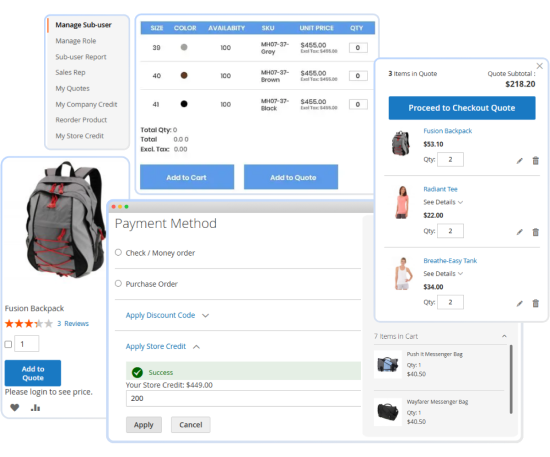
Key Highlights of the BSS Package:
- Democratizing B2B for Open Source: BSS allows small-to-medium enterprises (SMEs) running the free Open Source version to access “Enterprise-grade” tools.
- Advanced Visibility Control: Unlike the native suite, BSS includes “Hide Price” and “Force Login” features. This is vital for wholesalers who do not want competitors or retail customers to see their bulk pricing.
- Wholesale Registration: A specialized registration form that allows potential B2B clients to submit business certificates and tax IDs during sign-up, which the admin can then manually approve or reject.
- Flexible Shipping and Payment Rules: BSS allows you to restrict certain payment methods (like “Purchase Order”) or shipping methods only to specific B2B customer groups, providing much-needed checkout logic that is not natively flexible in the base Magento installation.
- High Customizability: Because the package consists of individual modules, you can choose to disable features you don’t need, potentially reducing frontend bloat.
Side-by-Side Comparison: Feature-by-Feature Analysis
To understand the practical differences, we must look at how these two solutions handle the same business requirements.
Feature Category | Native Magento B2B (Adobe Commerce) | BSS Commerce B2B Package |
Availability | Adobe Commerce Only | Open Source & Commerce |
Corporate Hierarchies | Deeply integrated, multi-level | Supported via “Company Account” module |
Catalog Customization | “Shared Catalogs” (Native feature) | “Category Permissions” & “B2B Pricing” |
Quoting System | Native negotiation workflow | Dedicated RFQ module with email triggers |
Pricing Privacy | Requires custom coding for “Hide Price” | Built-in “Hide Price / Call for Price” |
Bulk Ordering | SKU entry & CSV upload | SKU entry, CSV upload, & Fast Order UI |
Checkout Logic | Standard PO support | Granular rules for Shipping/Payment methods |
Technical Support | Official Adobe Support | BSS Vendor Support (Free for 1 year) |
Cost Structure | Annual revenue-based license | One-time purchase + optional updates |
Deep Dive: User Experience (UX) Comparison
Native Magento B2B offers a very “clean” and consistent UX because every feature was designed by the same core team. The UI/UX matches the standard Magento Luma or Hyva themes with minimal styling conflicts.
The BSS Commerce Package, being a collection of modules, provides a very feature-rich interface. However, because it adds many new buttons, tabs, and forms to the frontend, it requires a more careful configuration to ensure the design remains cohesive with your store’s theme.
Understanding the Total Cost of Ownership (TCO)
The financial impact of this choice is often the deciding factor for many businesses.
The Cost of Native (Adobe Commerce)
Adobe Commerce pricing is based on a tiered model tied to your Gross Merchandise Value (GMV).
- Licensing: Generally starts at $22,000+ per year.
- Hosting: Usually requires high-performance cloud hosting (Adobe Commerce Cloud or premium third-party hosting).
- Implementation: High. You need certified Magento developers who understand the Adobe Commerce ecosystem.
The Cost of BSS Commerce Package
BSS offers a much lower entry barrier for businesses that are budget-conscious but growth-oriented.
- Licensing: A one-time fee for the package (usually ranging from $600 to $1,200 depending on sales and support options).
- Hosting: Works on standard VPS or dedicated hosting suitable for Magento Open Source.
- Implementation: Moderate. While you still need a developer to install and configure 20+ modules, the complexity is generally lower than a full Adobe Commerce deployment.
Pros and Cons: A Realistic Assessment
Native Magento B2B
Pros:
- Unrivaled Stability: Being part of the core product means fewer bugs when updating Magento.
- Enterprise Security: Benefit from Adobe’s rigorous security standards and PCI compliance tools.
- Integrated Analytics: Native access to Adobe Sensei (AI) and advanced Business Intelligence (BI) reporting.
- Standardization: Easier to find agencies that know the standard Adobe workflow.
Cons:
- Prohibitive Cost: The licensing fee is a significant hurdle for startups and mid-market companies.
- Fixed Roadmap: You are dependent on Adobe’s schedule for new B2B features.
- Heavyweight: Can be “too much” for a business that only needs one or two B2B features.
BSS Commerce B2B Package
Pros:
- Exceptional Value: Provides 90% of the enterprise functionality at a fraction of the cost.
- Niche Features: Includes “Hide Price” and “Payment/Shipping Restrictions” which are surprisingly absent from the Native suite.
- Modular Nature: You can enable only what you need, keeping the admin interface cleaner.
- Open Source Compatibility: The only viable path for businesses that prefer the freedom of the Open Source edition.
Cons:
- Update Complexity: When Magento releases a new version, you must wait for BSS to update their modules, and then update each module individually.
- Potential for Conflicts: Installing 20+ extensions increases the risk of code conflicts, especially if you use other third-party modules (e.g., for SEO or a specific theme).
- Resource Intensive: Many extensions running at once can impact site speed if not properly optimized by a developer.
Strategic Decision: When to Choose Which?
Choosing between these two isn’t just about the features available today; it’s about where your business will be in three to five years.
Choose Native Magento B2B if:
- Your Annual Revenue is >$5M-$10M: At this scale, the licensing fee becomes a smaller percentage of your overhead, and the official support becomes invaluable.
- You Require Advanced Data Visualization: If you need deep insights into customer lifetime value, churn rates, and AI-driven product recommendations, Adobe Commerce’s BI tools are superior.
- You Have a High Complexity Internal Workflow: If your internal approval process involves multiple tiers of management across different global regions, the Native PO approval workflow is built for that level of enterprise complexity.
Choose BSS Commerce B2B Package if:
- You are on a Growth Path via Magento Open Source: If you want to keep your fixed costs low while testing the B2B market, this is the logical choice.
- You Need “Price Privacy”: If your business model relies on “Call for Price” or “Login to See Price,” the BSS package handles this natively, whereas Adobe Commerce requires a custom-built solution or additional extensions anyway.
- You Want Immediate Deployment of Specific Features: If you only need a Quick Order form and a Quote system, installing the BSS modules is faster than migrating your entire store to an Adobe Commerce license.
- You Value Granular Control over Checkout: If your wholesale clients need specific payment terms (like “Net 30” for Group A but “Credit Card Only” for Group B), the BSS Payment/Shipping rules module is more powerful than the native Magento settings.
Operational Challenges and Implementation Tips
Regardless of the path you choose, B2B e-commerce implementation is complex. Here are three tips for a successful rollout:
Tip 1: Prioritize Data Accuracy
Both Native B2B and the BSS Package rely heavily on your Customer Groups and Category Permissions. Before installing any software, audit your customer database. Ensure that your “Wholesale,” “Tier 1,” and “Distributor” groups are clearly defined.
Tip 2: Plan for Theme Compatibility
If you are using a custom theme or a popular third-party theme like Porto or Argento, expect that some styling adjustments will be necessary. Native B2B features usually integrate better with Luma-based themes, while BSS modules are well-supported but may require CSS tweaks to look “on-brand.”
Tip 3: Test the “Quote to Order” Flow Rigorously
The quoting engine is the heart of B2B. Ensure that tax calculations, shipping estimates, and discount codes work correctly when a quote is converted into a final order. In the BSS package, make sure the email notifications for quote requests are not being caught in spam filters, as this is the primary communication channel for your sales team.
Summary and Final Recommendation
The “Native Magento B2B vs BSS Commerce” debate ultimately comes down to Enterprise Stability vs. Modular Flexibility.
For the true enterprise player, Native Magento B2B offers a seamless, high-security environment that scales with multi-million dollar turnovers. It provides a level of “peace of mind” that comes with official Adobe backing, albeit at a premium price point.
For the agile mid-market wholesaler or the ambitious Open Source merchant, the BSS Commerce B2B Package is a game-changer. It bridges the gap between the basic retail capabilities of Magento and the complex needs of modern wholesale. While it requires a more “hands-on” approach to configuration and updates, the cost savings and the inclusion of niche features like “Hide Price” make it an incredibly attractive alternative.
If you are just starting your B2B journey or operating on Magento Open Source, start with the BSS Commerce Package. It will provide you with all the tools necessary to compete with enterprise giants without the enterprise price tag. If and when your business exceeds the $10M revenue mark, you can then consider the leap to Adobe Commerce and its native suite as part of a broader digital transformation.