

Product discovery is a critical but often underestimated part of the B2B buying journey. In the complex world of industrial supplies, medical equipment, or wholesale distribution, the “buy” button is merely the destination of a long and often arduous search. When buyers struggle to find the right products, technical specifications, or compatible configurations, conversions drop long before pricing or checkout becomes a factor. Unlike B2C retail, where discovery is often fueled by inspiration, B2B discovery is a high-stakes productivity task where efficiency is the primary metric of success.
Poor product discovery acts as a silent revenue killer, creating psychological barriers that exhaust the buyer’s patience and erode trust in the platform. This guide explains how poor product discovery hurts B2B conversions, why the impact is amplified in complex catalogs, and which technical and strategic fixes deliver the fastest ROI for enterprises. By moving beyond basic storefront functionality and focusing on the precision professional buyers require, businesses can transform their digital presence from a simple catalog into a high-performance sales engine.
Product discovery in a B2B context is the systemic process of connecting a professional buyer with the exact solution they need to solve a specific business problem. It is not limited to a simple search bar; it encompasses the entire site architecture, including navigation, filtering logic, and the presentation of technical data.
Differences between B2B and B2C product discovery behavior are stark. While a B2C shopper might search for “blue running shoes,” a B2B buyer is likely looking for “M8 stainless steel hex bolts with a 20mm thread length” or a specific SKU from a manufacturer’s catalog. This distinction means that B2B buyers expect extreme efficiency, precision, and control. They are searching to complete a professional task, meaning any delay in finding a part directly translates into business downtime.
The role of discovery spans the full buying journey. In the research phase, it helps a buyer identify potential solutions. In the shortlist phase, it allows for the comparison of technical specifications. In the reorder phase, discovery ensures that the buyer can find their specific contract-priced SKUs instantly. If discovery fails at any of these points, the conversion path is severed regardless of how competitive your pricing might be.
Poor discovery is more than an annoyance in B2B; it is a structural failure. B2B purchases typically involve longer decision cycles and higher financial stakes. A buyer who chooses the wrong part for an industrial machine doesn’t just lose time; they risk thousands of dollars in operational downtime and potential safety hazards. Consequently, the discovery experience must be accurate and authoritative.
Furthermore, multiple stakeholders often rely on the same discovery experience. An engineer might find the part, a project manager might verify the lead time, and a procurement officer might execute the purchase. If the discovery interface is confusing, it introduces friction into the collective decision-making process, causing the deal to stall.
B2B catalogs are inherently complex, often featuring thousands of SKUs and highly configurable products. When discovery is poor, this complexity becomes overwhelming. Friction in discovery compounds over time; if a buyer finds it difficult to find what they need for their first order, they are statistically unlikely to return for a second. This effectively caps the customer lifetime value (LTV) at a single transaction, preventing the recurring revenue model that sustains B2B growth.

The search bar is the most utilized discovery tool in B2B, yet it is often the most broken. Poor search relevance and a lack of synonym handling lead to “Zero Results” pages for queries that actually exist in the catalog but are phrased using industry jargon or slightly different spelling.
B2B buyers frequently search by SKUs, manufacturer part numbers, or obscure industry terms. If the search engine is not tuned to prioritize these exact-match identifiers, the buyer is forced to sift through irrelevant results. A lack of “recovery paths”—such as suggesting alternative products when an exact SKU is out of stock—sends the buyer directly to a competitor’s site who makes the discovery process easier. You can find the best Magento extensions to resolve search issues to help customers navigate these empty result pages.
Many B2B sites suffer from taxonomy debt. This occurs when the category structure is either too flat, forcing the user to scroll through 1,000 items, or overly deep, requiring ten clicks to find a specific sub-category.
Friction arises when the site’s taxonomy is misaligned with the buyer’s mental model. If an engineer searches by application but the site is organized by material type, the discovery process feels unintuitive. Often, category pages are optimized for SEO keywords at the expense of user navigation, creating a disconnect between how bots find the page and how humans actually use it.
Faceted navigation should be a tool for precision, but it often becomes a source of frustration. Many stores offer too many filters that provide little value, while missing critical B2B attributes like dimensions, voltage, compatibility, or certifications.
Filter UX issues are particularly prevalent on mobile and tablet devices, which are increasingly used by field engineers. Clunky overlays or “jumpy” updates that reset the user’s scroll position make it impossible to select multiple attributes efficiently. Without a high-performance filtering system, discovery becomes a trial-and-error process that professional buyers simply will not tolerate.

Inconsistent product data across similar SKUs is a major conversion killer. If one SKU lists weight in kilograms and the next in pounds, the buyer cannot easily compare them. This lack of standardized information architecture forces the buyer to do manual math, increasing cognitive load and the margin for error.
Key decision data is often buried behind unnecessary tabs or hidden in downloadable PDF links. While PDFs are useful for archival purposes, the most important specs for discovery must be scannable and present in the HTML to assist both the user and the search engine’s understanding of the page context.
Expecting B2B buyers to “figure it out” themselves is a recipe for high bounce rates. Complex products often require solution-based or use-case navigation (e.g., “Find the right pump for chemical processing”).
The absence of intelligent product recommendations or compatibility cues is another significant gap. In a high-converting B2B store, the discovery system acts as a digital sales consultant, proactively suggesting the required accessories or compatible parts based on the items currently being viewed.
The technical failures of discovery translate directly into poor business performance. The most visible impact is increased bounce rates on category and search pages. If a user lands from a search engine and cannot find a path to the specific item they need within three seconds, they leave.
Lower add-to-cart (ATC) rates are another symptom. High-intent traffic might reach your site, but if the filtering logic is too weak to help them select the correct variant, they will never click the purchase button. In B2B, this is often misdiagnosed as a pricing issue when it is actually a findability issue.
Furthermore, poor discovery destroys reordering efficiency. A procurement officer who buys from you every month expects to spend less than two minutes on your site. If they have to re-discover the same products every time because the search or account area is clunky, the purchase frequency will eventually drop. Finally, poor discovery increases the operational load on your sales and support teams, as buyers call to ask basic questions that should have been answered by the website’s UI.
Identifying discovery issues requires looking beyond standard traffic numbers. Understanding how poor product discovery hurts B2B conversions is the first step in diagnosing these warning signs. Investigating why customers can’t find products in Magento 2 helps you pinpoint specific navigation or data gaps.
Search optimization delivers the fastest conversion gains in B2B because it caters to the highest-intent users.
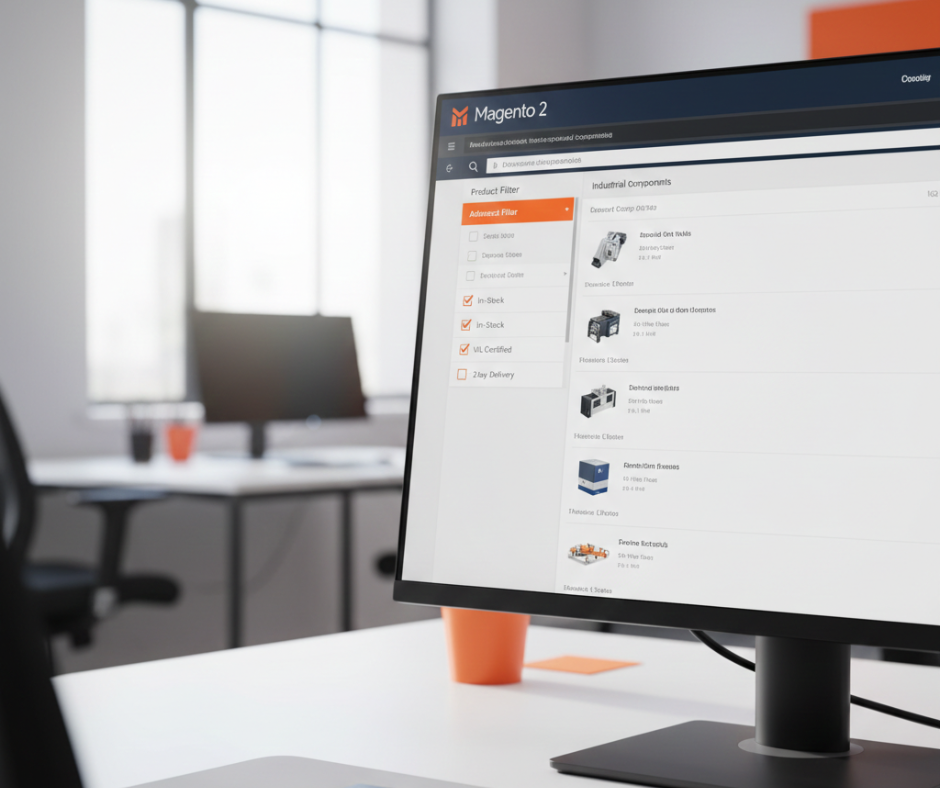
Reduce cognitive load by designing filters around buyer decision criteria rather than just your internal database attributes.
Make specifications scannable. Use comparison tables that allow users to select 3-4 similar SKUs and see their technical attributes side-by-side. For products with many variants, use a grid view for selection rather than a dropdown. This allows the buyer to see all availability and prices at once, which is far more efficient for bulk procurement.
Standard Conversion Rate Optimization (CRO) tactics, such as changing button colors or shortening checkout forms, will fail if the underlying discovery process is broken. You cannot optimize a checkout for a product the user never found.
Discovery is the prerequisite for checkout optimization. It is the “Top of the Funnel” inside the website itself. Aligning UX, SEO, and conversion goals means recognizing that a search bot and a professional buyer are looking for the same thing: clear, structured, and easily accessible information. When you fix discovery, you are essentially cleaning the clutter that prevents your CRO tactics from working.
To track the success of your improvements, you must monitor specific interaction metrics.
Using analytics and session recordings is essential to spot discovery friction. Watching a user rage-click a filter that doesn’t update or seeing them repeatedly retype a search query provides qualitative evidence that technical fixes are required.
Product discovery should be treated as a system, not a one-time feature. As your catalog grows from 1,000 to 100,000 SKUs, your discovery UX must scale accordingly. This requires a data-first mindset where product data accuracy is maintained as a core business function.
A successful long-term strategy involves aligning your product data, UX, and merchandising teams. Merchandising should identify high-margin products, UX should ensure they are discoverable via guided selling tools, and data teams must ensure the attributes powering those tools are accurate. A healthy stack of Magento 2 extensions can transform a static catalog into a high-performance procurement engine that evolves with your business.
Poor product discovery is a silent revenue killer because it prevents high-intent buyers from even reaching the transaction stage. In the B2B world, where time is money and accuracy is paramount, your discovery experience is your most important sales tool. Understanding exactly how poor product discovery hurts B2B conversions allows you to prioritize the technical fixes that matter most.
Fixing discovery is not just about a better search bar; it is about building a digital environment that respects the complexity of B2B procurement. By prioritizing search relevance, simplifying filters, and making technical data scannable, businesses can unlock massive conversion gains. Before spending more on checkout optimization or paid ads, ensure that your customers can actually find what they are looking for. The business case is clear: discovery is the foundation upon which all other e-commerce success is built.
